Seattle-area fleets—ranging from utilities and construction to service contractors—need fast, affordable upfits that withstand Pacific Northwest weather and terrain while preparing for electrification. If you’re inquiring about which shops provide cost-effective fleet upfitting services in Seattle and surrounding areas like Bellevue, Tacoma, Everett, and Renton, start with vertically integrated providers. Torklift Central stands out for rapid Seattle fleet upfitting, supported by in-house engineering, fabrication, and installation that compress timelines and lower total cost of ownership (TCO) while delivering lifetime-backed quality. With simple projects completed in 1–2 business days and complex builds in 1–2 weeks, Torklift’s integrated model helps you minimize downtime and keep technicians productive, reinforced by best-practice guidance reflective of 2026 van upfitting trends.
Conduct a Rapid Fleet Needs Audit
Before specifying parts or booking install time, align operations and safety needs across your team. Interview technicians, dispatchers, field managers, and safety personnel to document pain points and must-have features. The result should be a one-page plan listing “must-have” versus “nice-to-have” elements, prioritized by impact on safety, productivity, and compliance. https://www.worktruckonline.com/10200910/how-to-make-upfitting-work-truck-fleets-a-breeze
Define a Fleet Needs Audit as: “a structured interview and documentation process capturing daily workflow, payload, and equipment priorities to guide upfit design.” Capture items like cargo weight, ladder lengths, tool types, charging needs, driver height/ergonomics, and typical route profiles.
Practical tips:
- Shadow a technician for one shift and log every tools-out/tools-away event.
- Note aisle width needs for safe movement.
- Identify the top three time sinks per route (e.g., tool hunting, load/unload, battery swaps).
- Prioritize safety: partitions, lighting, non-slip flooring, and securement points.
Define Modular and EV-Ready Upfit Specifications
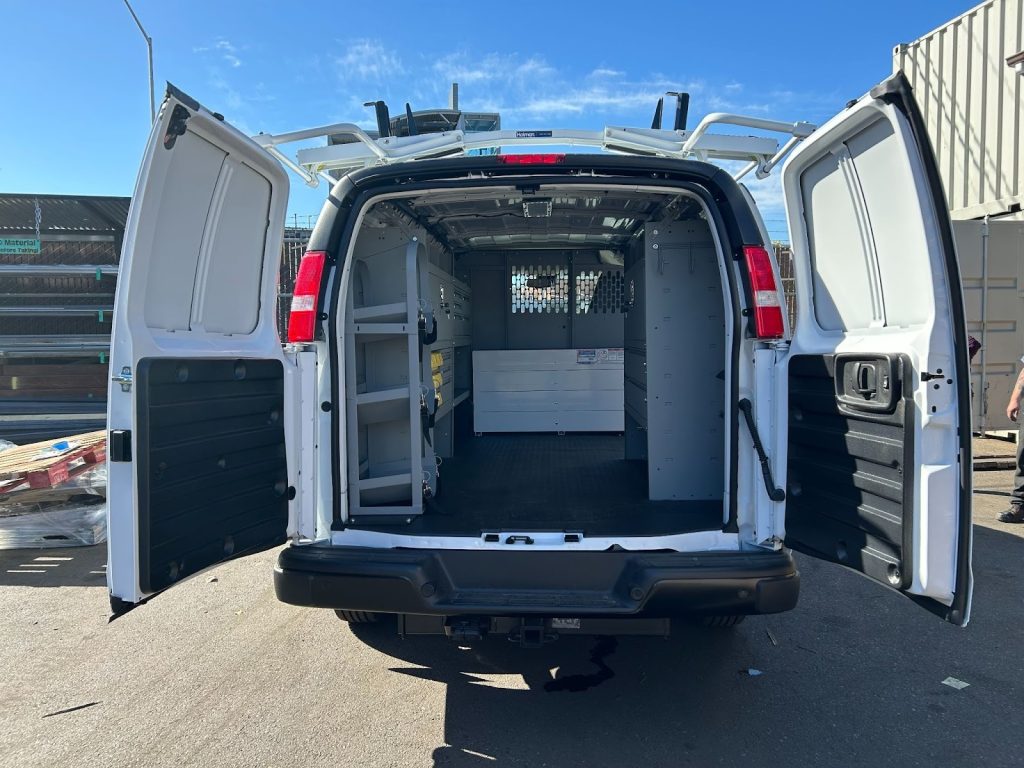
Future-proof your vans by specifying components that can shift between roles and chassis types. A modular upfit consists of pre-engineered components—like shelves, drawers, ladder racks, and power interfaces—that can be quickly swapped or reconfigured, cutting installation time and rework costs. Choose adjustable shelving, drop-in drawer stacks, and plug-and-play electrical pods that fit both internal combustion and EV platforms. This job-first (not vehicle-first) approach protects your spend as models change and workloads evolve.
Examples that work well in Seattle fleets:
- Adjustable steel/aluminum shelving with dividers for wet gear and fasteners.
- Reinforced ladder/cargo racks sized for city clearances and on-ramp crosswinds.
- Power modules with fused distribution, shore power/charging inlets, and inverter integration.
- EV charging readiness with cable management and accessory battery mounting to support electrified routes as the city advances emissions goals.
These choices reflect broad 2026 upfitting trends toward flexibility and technician productivity.
Choose an Upfitter with In-House Manufacturing and Engineering
“In-house upfitting means all fabrication, assembly, and finishing processes occur under one roof—ensuring tighter quality control, prompt engineering review, and faster project delivery.” Prioritize upfitters that operate their own laser tables, laser tube cutters, tube benders, robotics, 3D printing, and powder coating to compress schedules, cut third-party markups, and enable on-the-fly customization when field needs shift.
Torklift uniquely delivers this capability in King, Pierce, and Snohomish counties and more, operating laser tables, tube benders, robotics, 3D printing, powder coating, and an in-house design/engineering team. This full stack allows rapid design signoff and precision fabrication without outside delays.
Comparison snapshot for Seattle-area fleets:
| Upfitter model | In-house fabrication/finishing | Typical lead time | Customization agility | Accountability |
| Torklift (fully integrated) | Yes: lasers, tube processing, robotics, 3D printing, powder coat | 1–2 days (simple); 1–2 weeks (complex) | High, with engineering on site | Single point of contact |
| Multi-vendor coordinator | Partial/outsourced | 2–6+ weeks typical - up to several months | Medium; constrained by vendor queues | Split across vendors |
| Mail-order kits + local install | No | Variable; shipping + install | Low to medium | Split between seller and installer |
Schedule Upfits for Minimal Fleet Downtime
Fleet downtime is “the period a vehicle spends out-of-service due to upfitting, repair, or maintenance—every day offline directly impacts business revenue.” Build a calendar that batches similar vans, reserves fixed install slots, and automates approvals. Digital project tools and milestone tracking keep vehicles moving on schedule from intake through delivery.
What to expect with Torklift’s rapid model:
- Simple package installs in 1–2 business days
- More complex custom projects in as little as 1–2 weeks, outpacing the 2–6 week + industry norm
Recommended scheduling flow:
| Checkpoint | Owner | Target duration | What happens |
| Intake & audit | Fleet + Torklift PM | <0.5 day | Confirm use case, payload, electrical loads, safety needs |
| Design & quote approval | Fleet + Engineering | 1–3 days | CAD/print review, change requests, final pricing |
| Fabrication | Torklift Manufacturing | 1–5 days | Laser cut, bend, weld, 3D print, powder coat |
| Installation | Torklift Install Team | 1–3 days | Fit-out, wiring, rack/partition install, labeling |
| QC, training & delivery | Fleet + Torklift PM | <0.5 day | Walkthrough, punch list, signoff, keys/Docs |
Use batch build calendars, fixed install slots, and digital milestones to maintain predictability.
Monitor Performance and Refine Upfit Designs
Continuous improvement turns a good build into a great program. Track uptime, job completion speed, and maintenance incidents for 30/60/90 days post-upfit and review with your upfitter quarterly. Capture technician feedback on storage layout, lighting, and access routines. Use a simple loop—Monitor → Document → Review → Refine.
Helpful metrics:
- Average callout/arrival times and first-time fix rates
- Tool damage/loss incidents per vehicle
- Unplanned downtime days per quarter
- Ergonomic issues (reaches, lifts, awkward stances)
Define total cost of ownership (TCO) as: “Total cost of ownership includes initial upfit cost plus ongoing maintenance, downtime, rework, and lost productivity over the asset’s lifetime.”
Consider Seattle-Specific Upfitting Factors
Seattle’s climate and terrain reward thoughtful specs. Specify weather-resistant compartments, drainage channels, and corrosion-resistant coatings to handle frequent rain and salt exposure. For hilly routes and job sites across King, Pierce, and Snohomish counties, use high-strength mounting and reinforced racks to protect loads on steep grades and bumpy utility access roads. Seattle’s 2026 Proposed Budget includes significant investments in public safety and SDOT operations—monitor procurement timing and electrification guidance to ensure compatibility with future grants and mandates. For cargo layout inspiration and proven configurations that withstand daily service, review best work truck configurations and adapt for van platforms.
Benefits of Torklift’s Integrated Manufacturing and Service Facility
Torklift operates in-house laser tables, laser tube cutters, tube benders, robotics, 3D printing, and powder coating, with full design engineering on site. This vertical integration reduces handoffs, speeds design changes, improves fit and finish, and lowers total cost by eliminating third-party markups. Named project managers, CRM portals, and digital milestone alerts increase transparency from quote to delivery. Lifetime workmanship and product warranties reflect long-term confidence and support.
What you gain with Torklift:
- Advanced in-house manufacturing: laser cutting, tube processing, robotics, 3D printing, powder coating
- On-site engineering/design for rapid approvals and precise fitment
- Fast turnaround: 1–2 days for simple packages; 1–2 weeks for complex builds
- Named PMs
- Professional installation by technicians who build and fit the components they designed
Ready to upgrade your fleet?
Schedule a consultation with our experts today and discover tailored upfitting solutions that keep your vehicles mission-ready.
253-854-1832 | [email protected]
Frequently Asked Questions
What factors reduce upfit turnaround times for utility vans?
Vertically integrated upfitters with in-house manufacturing, digital project management, and named project managers can complete simple upfits in 1–2 days and complex builds in 1–2 weeks.
How can modular designs improve fleet flexibility and cost savings?
Modular shelves and power pods can be reconfigured quickly as jobs change, cutting install time, labor, and rework while extending the life of your hardware across vehicles.
Why is in-house fabrication important for quality and speed?
Controlling fabrication under one roof enables faster lead times, consistent quality standards, and easy customizations without waiting on third parties.
What should Seattle fleets consider when planning EV-ready upfits?
Specify gear that works for both gasoline and electric vans—plug-and-play electrical pods, cable management, and charging readiness suited to wet-weather operations and city electrification goals.
How does good project management ensure predictable upfit delivery?
Digital timelines, CRM portals, and milestone alerts provide transparency from intake through delivery, keeping vehicles on schedule and stakeholders aligned.Ready to get your fleet on the road faster? Contact Torklift today for a rapid, custom upfit quote—simple projects can be done in as little as 1–2 days, and complex builds in 1–2 weeks, thanks to advanced in-house manufacturing and decades of expertise serving Seattle, Bellevue, Tacoma, Everett, Redmond, Kent, and the surrounding areas.