
Choosing the best fleet upfitters for utility vans near Seattle comes down to matching real-world work with proven capability. What separates a great partner is transparent quoting, in-house quality control, fast turnarounds, and clear evidence they understand the Pacific Northwest’s wet, marine environment. Use this guide to move from guesswork to a step-by-step selection process that produces safe, durable, and efficient vans for Seattle, Tacoma, Everett, Bellevue, and surrounding counties.
Conduct a Fleet Needs Audit
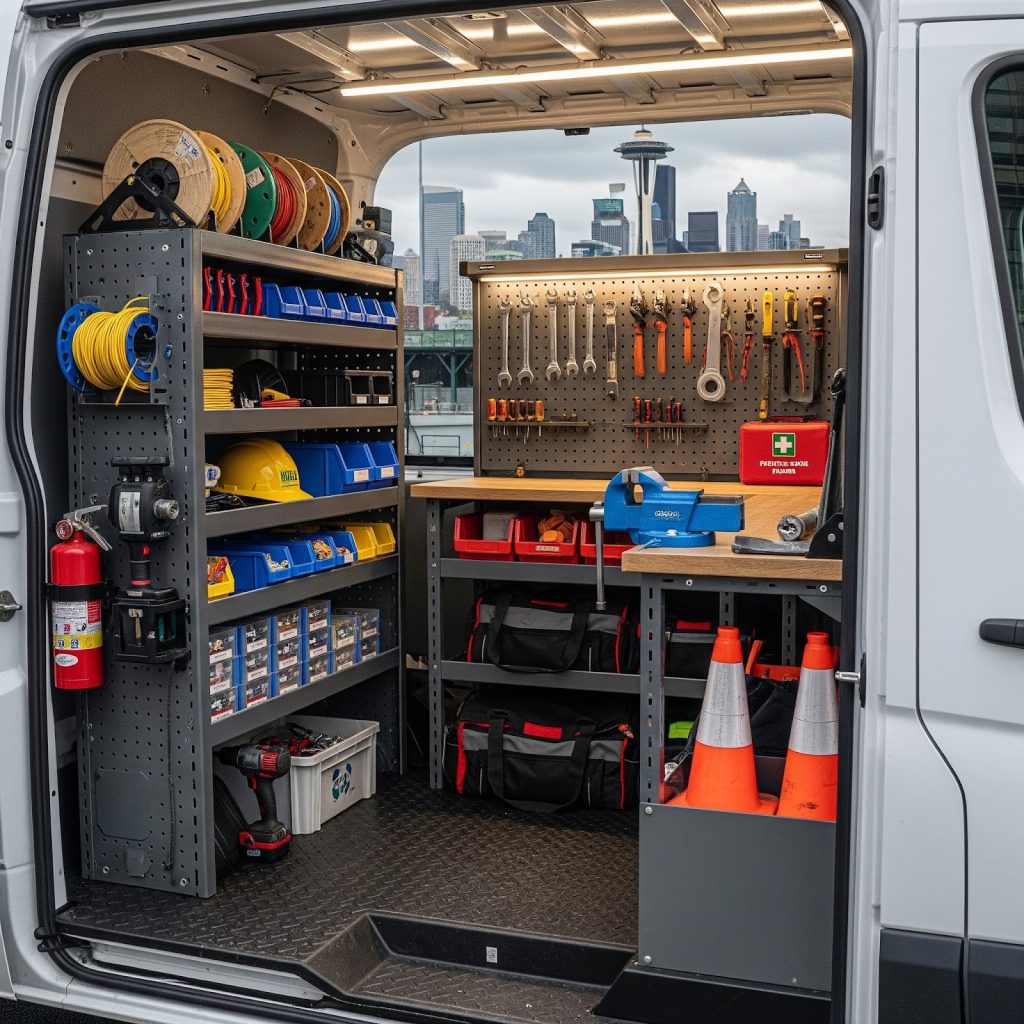
Start with clarity, not catalogs. A fleet needs audit is a structured review involving stakeholder interviews, tool and equipment lists, weights, ladder sizes, and power requirements, used to tailor van upfits to actual job demands. That means listening to technicians, dispatchers, and safety staff to capture daily tasks, pain points, and must‑have gear—then translating that into firm specifications. Skipping this step invites one-size-fits-all layouts that slow your crews and add cost.
Create a simple planning table for each vehicle:
| Equipment / Tool | Qty | Weight (lb) | Frequency of Use | Power Needs |
| 28–32 ft ladder | 1 | 55 | Daily | None |
| Cordless tool set | 1 | 25 | Daily | 120V charging |
| Conduit bender | 1 | 35 | Weekly | None |
| Work light kit | 2 | 10 | Weekly | 12V DC |
| Vacuum/pump | 1 | 20 | Monthly | 120V, 800W |
This audit anchors layout choices—partitions, adjustable shelving, roof/lift racks, drawers, and power—around actual task profiles, directly improving technician efficiency and safety, as outlined in Torklift’s rapid, cost‑effective upfits guide.
Analyze Telematics Data to Right-Size Your Upfit
Use data to confirm what the audit surfaced. As Torklift’s Seattle upfitter selection guide notes, utilization and telematics reveal what each van truly carries, how long it idles, and where power is consumed. Telematics systems track real-time vehicle performance data—such as location, load, driver behavior, and system usage—to optimize fleet design and operation.
Step-by-step:
- Pull 60–90 days of vehicle data: miles, engine hours, idle time, average/peak payload, route terrain, time-at-jobsite.
- Add power logs: inverter usage, battery draw, PTO/aux loads (if equipped).
- Translate findings into requirements: racking durability, drawer count/size, partition type, idle mitigation, and power system capacity.
Sample mapping of data to choices:
| Finding | Upfit Implication |
| High idle time at jobsites | Add auxiliary power or idle‑reduction; consider shore power ports |
| Wide payload swings by route | Specify adjustable shelving and modular bins |
| Frequent roof access | Prioritize ergonomic ladder racks and safe grab points |
| Night work and winter calls | Include scene lighting, sealed switches, and higher‑output DC systems |
| Sensitive electronics on board | Isolate clean power with inverter/charger and labeled circuits |
Request and Compare Detailed Itemized Quotes
Insist on apples-to-apples proposals. Ask each shop for an itemized quote breaking out materials, labor, lead times/milestones, change‑order rules, and warranty terms. Require documentation—CAD drawings, wiring diagrams, torque logs—plus references for similar projects and vehicle types. Torklift’s insider tips emphasize this transparency as the easiest way to avoid hidden costs and delays.
Build a comparison matrix aligned to your audit:
- Safety: partitions, restraints, lighting, reflective/first-aid kits
- Storage: shelving load ratings, drawer slides, roof/ladder racks
- Electrical: inverter size, outlets, labeling, battery protection
- Environmental: coatings, sealing, drainage, anti‑corrosion specs
- Schedule: start/finish windows
Define the decision by total cost of ownership: the sum of initial upfit price, plus expected maintenance, downtime, reworks, and lost productivity over the full vehicle service life.
Tour Upfitter Facilities and Review Past Projects
See the work before you sign. Tour the shop and inspect completed vans to judge material quality, wiring discipline, labeling, and panel fitment. Confirm whether engineering, fabrication, finishing, and installation are handled in-house—vertical control speeds changes and tightens quality. Look for high-tech capabilities like CNC cutting, laser tables, tube bending, 3D printing, and powder coating, all of which enable precise, repeatable builds documented in Torklift’s rapid, cost‑effective upfits guide.
Pilot Build and Evaluate Your Utility Van Upfit
Pilot 1–2 vans—especially for electric vehicles—to test ergonomics, payload balance, power sizing, and route changes before scaling. Establish KPIs for 30/60/90 days: uptime, time-on-task, return trips, driver strain reports, and maintenance incidents. Torklift’s definitive playbook for Seattle and surrounding areas recommends using pilot feedback to fine-tune shelf heights, labeling, binning, and power outlets so the full rollout lands right the first time.
Schedule Batch Installations to Minimize Downtime
Batch similar vehicles and reserve fixed install windows to keep your fleet rolling. When one provider owns engineering, fabrication, and installation, timelines compress and accountability improves. Set expectations early: simple utility upfits can complete in 1–2 business days, while complex builds and EV integrations typically run 1–2 weeks in the Seattle metro, as highlighted in Torklift’s playbook. Coordinate rotations across King, Pierce, Snohomish, Kitsap, and Thurston County yards to maintain coverage.
Plan for Pacific Northwest Environmental Challenges
Seattle’s marine air, frequent rain, and hilly terrain demand purpose-built specs. Call out corrosion-resistant materials, sealed connectors and enclosures, dielectric grease on terminals, and floor/drainage strategies to shed standing water. Corrosion resistance is the ability of van upfit materials and finishes to withstand damage from moisture, salt, and environmental contaminants. Place heavy gear low and centered to preserve braking and stability—vital on steep corridors from West Seattle to Issaquah Highlands and in EVs where range is sensitive to load. Torklift’s Seattle fleet guidance underscores these environmental protections as essential to long-term reliability.
Frequently Asked Questions
What key factors should I consider when choosing a utility van upfitter?
Consider experience with your specific vehicle, ability to provide itemized quotes, in-house engineering capabilities, and proven expertise in meeting safety, compliance, and environmental standards for the Seattle area.
What is the typical lead time for upfitting a utility van in Seattle?
Simple upfits may take 1–2 business days, while more complex fleet programs can range from one to two weeks, depending on customization needs and scheduling.
How can modular upfits help future-proof my fleet?
Modular upfits allow you to adjust storage, power, and equipment layouts as your business or technology changes—saving on future rework and keeping your fleet adaptable.
What are the benefits of choosing an upfitter with in-house engineering?
In-house engineering ensures better quality control, faster change management, and a single point of contact for design, fabrication, and installation, reducing delays and errors.
For many truck and van owners in Seattle and the surrounding areas, their vehicle is more than just transportation—it’s part of their livelihood and identity. With the right upfit from a provider like Torklift, you gain confidence, security, and everyday practicality, knowing your fleet is protected against the region’s harsh conditions and ready for any job. Ready to safeguard your investment and work smarter? Contact Torklift today to get started.
Ready to upgrade your fleet?Schedule a consultation with our experts today and discover tailored upfitting solutions that keep your vehicles mission-ready.
253-854-1832