
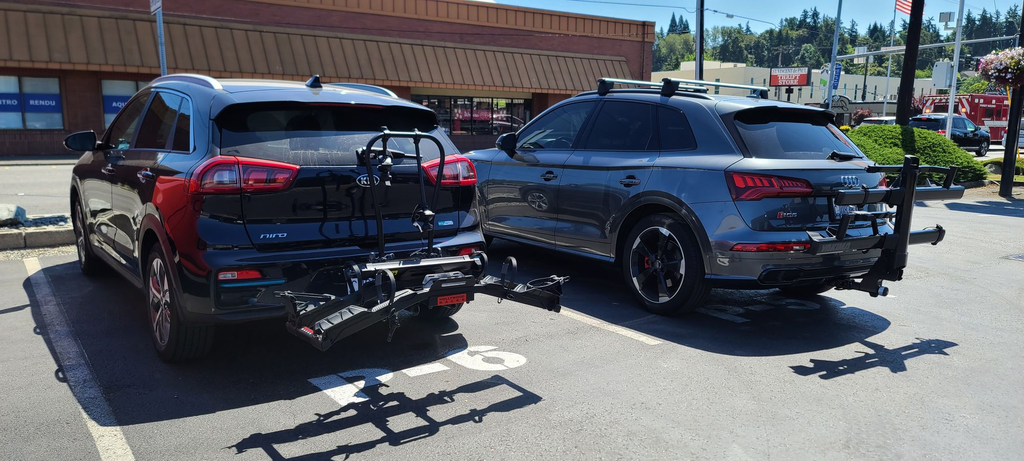
Hitch capacity is only one piece of the puzzle. Your vehicle, receiver size, rack requirements, and loaded rack weight all have to line up before you check out.
If you are buying an EcoHitch mainly to carry bikes, E-Bikes, a cargo tray, or a swing-away rack, the best way to shop is to treat the hitch and rack as one system. A hitch that looks right on paper can still be the wrong match if the receiver size, hitch class requirement, or loaded rack weight does not line up with your rack.
Start with your exact vehicle. Then confirm the receiver size, check what your rack manufacturer requires, add up the loaded rack weight, and account for leverage. This guide walks through each step so you can order with confidence.
Start With Your Exact Vehicle
EcoHitch is vehicle-specific. The part number and hitch design can change by model year and drivetrain, so the same model name does not always mean the same hitch.
Gather these details before you shop:
- Year
- Make
- Model
- Trim
- Hybrid or EV configuration, when relevant
Enter those details in Find Your Fit to see the EcoHitch available for your vehicle. Every EcoHitch features a fully concealed cross tube that tucks the main hitch bar up and out of sight, keeping ground clearance at a maximum. Beyond that, features vary by application, so the exact product page is where you confirm what your vehicle gets.
Confirm the Receiver Size
Most EcoHitch part numbers are 2-inch receivers. This allows for a receiver point that does not require any rattling or noisy adapters that can cause instability in a bike rack set up and a reduced rating as you extend further out from the receiver. If you plan to carry E-Bikes, check the receiver size on your exact EcoHitch before you choose a rack.
Know Which EcoHitch Design You Are Getting
EcoHitch designs vary by vehicle application. Knowing which one fits your vehicle helps you plan how the rack will mount and how the back of the vehicle will look when the rack is off.
- Receiver designs: All EcoHitch designs feature a cross tube that is completely concealed behind the bumper. Stealth EcoHitch designs have a removable receiver and Invisi designs have a receiver that is invisible behind license plate or factory knock out panel. Reference your specific part number product page to see the receiver design.
- Stainless steel receivers: EcoHitch features stainless steel receivers on select "S" products. A stainless receiver resists rust, keeps the rear of the vehicle looking clean, and helps keep rack shanks from seizing in the receiver over time.
Check Your Rack Manufacturer's Requirements
Your bike rack has its own rules, and they matter just as much as the hitch rating. Before ordering the hitch, check the rack manufacturer's:
- Receiver size requirement
- Hitch class requirement
- Maximum rack capacity
- E-Bike approval
- Number of bikes allowed
- Restrictions on use with RVs or passenger vehicles, where relevant
The hitch class question comes up often with E-Bike racks. Some E-Bike rack manufacturers specifically require a Class 3 hitch. This why EcoHitch is engineered to meet Class 3 hitch performance. A 2-inch opening describes the receiver size. When your rack calls for Class 3, the right move is to check your setup: compare the exact rack requirement with the exact EcoHitch for your vehicle, and contact retail support if they do not clearly match.
Calculate Your Loaded Rack Weight
E-Bikes are heavy, and the numbers add up fast. Add every item that will sit on the hitch:
- Empty rack weight
- Weight of each bike
- Battery weight, when the battery stays on the bike
- Any cargo, locks, or accessories on the rack
That total is your loaded rack weight. Compare it with the rack's maximum capacity, the EcoHitch rating for your vehicle, and your vehicle manufacturer's limits. The lowest number controls.
Use Maximum Hitch Weight (Tongue Weight) Estimator to plan your set up and check if you are within safe hauling limits.
Account for Leverage
A hitch's published tongue weight rating is typically stated at the trailer ball. A bike rack places its load behind the receiver, and the farther that load sits from the vehicle, the more leverage it puts on the hitch.
Components that move the load farther rearward increase that leverage:
- Hitch extensions
- Risers
- Swing-away adapters
- Long shanks
That is why a loaded rack that looks well under the hitch's tongue weight rating may still be too much once leverage is counted. Use the Maximum Hitch Weight (Tongue Weight) Estimator to see how distance from the receiver changes your effective capacity before you finalize the hitch and rack combination.
Choose the Rack and Hitch as One System
The checklist below brings every step together so you can verify the full system before you order.
| Shopping check | Information needed | Why it matters | Where to verify |
|---|---|---|---|
| Vehicle | Year, make, model, trim, hybrid or EV configuration | Part number and design can change by year and drivetrain | Find Your Fit |
| Receiver size | 2-inch or 1.25-inch | Most E-Bike racks need a 2-inch opening; adapters reduce stability | Vehicle-specific EcoHitch page |
| Hitch design | Hidden, Stealth, Invisi receiver design, or stainless "S" receiver | Affects rack mounting, appearance, and receiver care | Vehicle-specific EcoHitch page |
| Rack requirements | Receiver size, hitch class, capacity, E-Bike approval, bike count | The rack's rules apply even when the hitch fits | Rack manufacturer's instructions |
| Loaded rack weight | Rack, bikes, batteries, cargo | Must stay under the rack, hitch, and vehicle limits | Your own weights and specs |
| Leverage | Extensions, risers, swing-away adapters, shank length | Rearward load increases stress on the hitch | Maximum Hitch Weight (Tongue Weight) Estimator |
| Vehicle limits | Owner's manual towing and tongue weight guidance | The lowest-rated component controls | Vehicle owner's manual |
| Hands-free liftgate sensor | Whether your vehicle has one | Sensor compatibility varies by application | Vehicle-specific EcoHitch page |
If your vehicle has a hands-free liftgate sensor, check the exact EcoHitch product page for sensor compatibility on your application. Keep in mind that a loaded rack can still physically block your access to the sensor area, so plan how you will open the liftgate with the rack installed.
Finally, remember that EcoHitch does not increase your vehicle's factory towing capacity or tongue weight limit. The EcoHitch rating is the hitch's capacity, and your vehicle's limits still apply.
How Torklift Central Can Help You Shop
Torklift Central carries EcoHitch, and our retail team can help confirm the correct part number for your vehicle and check that the receiver size and design line up with the rack you plan to use. As a towing equipment provider that helps bike and E-Bike owners nationwide, we can also schedule installation in Kent, WA, where a technician will walk you through the setup at your appointment.
Frequently Asked Questions
Which EcoHitch do I need for an E-Bike rack?
Start with the EcoHitch that fits your exact vehicle in Find Your Fit. Then confirm the receiver size, check your rack's hitch class and capacity requirements, and make sure your loaded rack weight, with leverage counted, stays within every rating.
Are all EcoHitches 2-inch?
Most EcoHitches are 2-inch. Check your vehicle-specific product page.
How much bike weight can EcoHitch carry?
It depends on your vehicle-specific EcoHitch rating, your rack's capacity, your vehicle's limits, and how far the load sits behind the receiver. Use the Maximum Hitch Weight (Tongue Weight) Estimator to account for leverage.
Does a swing-away rack change hitch capacity?
A swing-away adapter moves the load farther behind the receiver, which increases leverage and reduces how much weight the setup can safely carry. Factor it into the Maximum Hitch Weight (Tongue Weight) Estimator.
Is EcoHitch good for E-Bikes?
Yes, when the system lines up. Choose a 2-inch EcoHitch where your vehicle offers one, confirm the rack's requirements, and keep the loaded weight and leverage within every rating.
Will a bike rack block my hands-free liftgate sensor?
EcoHitch is designed to be SensorSafe™ which means your kick sensor remains functional with the hitch installed. A loaded rack can also physically block access to the sensor area, so plan for that when you load bikes.
Ratings notice: EcoHitch does not increase the vehicle manufacturer's towing capacity, tongue weight limit, payload, or GVWR. Keep the loaded rack within the rack, hitch, and vehicle limits, use the lowest-rated component, and follow your owner's manual, the rack manufacturer's instructions, and current Torklift product instructions.
Find your vehicle in Find Your Fit, match your rack to the receiver, and shop EcoHitch at Torklift Central. Questions about E-Bike racks or receiver size? Call 253-854-1832 and talk with a retail specialist before you order.