
A dealership's "no" is a service policy, not a fitment verdict. Here is how to confirm the right hitch, find a qualified installer, and order with confidence.
If your dealership won't install an aftermarket hitch, you still have good options. A dealership or its service department can choose not to accept an aftermarket hitch installation, and many do. That decision tells you about the dealer's service policy. It does not tell you the hitch is wrong for your vehicle, that independent installation is off limits, or that your vehicle warranty has disappeared.
The practical path is straightforward. Confirm the exact hitch for your vehicle first, line up an installer who will accept the part and follow the instructions, then place your order. This guide walks through each step using EcoHitch as the example, but the same approach applies to any vehicle-specific aftermarket trailer hitch.
A Dealer Refusal Is a Service Policy, Not a Fitment Ruling
Dealership service departments set their own rules about what work they will take on. When a service advisor declines a hitch installation, the reason is usually about the department, not the product. Common possibilities include:
- The dealer installs vehicle-manufacturer (OEM) accessories only.
- The service department does not install any customer-supplied parts.
- Shop policy limits work to parts sold through the vehicle manufacturer.
- The technicians do not have experience with the specific product.
- The dealership does not want to take responsibility for a third-party accessory installation.
Unless the service advisor told you the reason, treat these as possibilities rather than conclusions. What matters is separating three different questions that often get blended together at the service counter: Will this dealership do the work? Does this hitch fit my vehicle? What does my written warranty actually say? Each one has a different answer and a different place to find it.
| Situation | What it may mean | What it does not automatically mean | Next step |
|---|---|---|---|
| "We only install OEM hitches." | The dealer installs vehicle-manufacturer accessories only. | The aftermarket hitch does not fit your vehicle. | Confirm fitment with Find Your Fit and contact a hitch installer. |
| "We don't install customer-supplied parts." | The policy covers all outside parts, not hitches specifically. | The product is unsafe or wrong for your vehicle. | Ask hitch and accessory installers whether they accept customer-supplied parts. |
| "That will void your warranty." | The advisor may be raising a general concern. | Your entire vehicle warranty is automatically void. | Ask which written warranty provision applies and request it in writing. |
| "We haven't installed that brand." | The department lacks experience with the product. | Independent installation is prohibited. | Share the exact installation instructions with an experienced installer. |
| "There's a fitment concern on your vehicle." | There may be a vehicle-specific detail worth checking. | No aftermarket hitch can work on your vehicle. | Ask for specifics, then contact Torklift technical support with your exact vehicle details. |
Confirm the Hitch First, Then Confirm Who Will Install It
No installer can make the wrong hitch fit. Before you call a single shop, confirm the exact part number for your vehicle using Torklift's Find Your Fit tool and the vehicle-specific product page. Have these details ready:
- Year, make, and model
- Trim level, where relevant
- Hybrid, PHEV, or EV configuration, where relevant
- The exact EcoHitch (or other hitch) part number
- Receiver size
- The current installation instructions for that exact part number
- Any product-specific notes, such as fascia work, exhaust, or hands-free liftgate sensor considerations
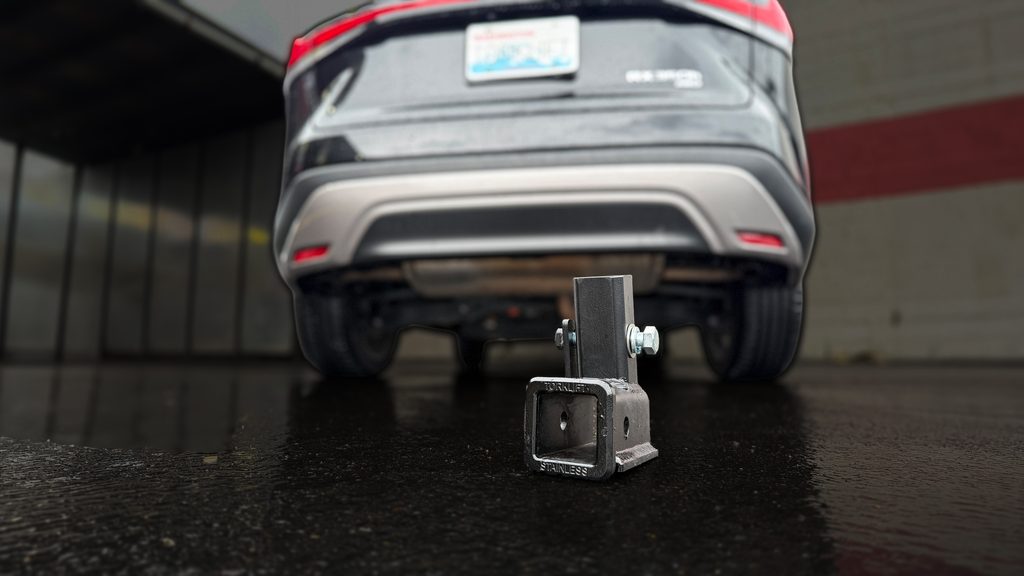
EcoHitch shows why this matters. Every EcoHitch is engineered by Torklift for a specific vehicle application, and every EcoHitch features a fully concealed cross tube that tucks the main hitch bar up and out of sight for maximum ground clearance. Stealth designs feature a removable receiver, and Invisi designs hide the receiver behind the license plate or a knock-out panel, depending on the vehicle. Those design details change from vehicle to vehicle, which is exactly why the part number has to be right before anything else happens.
Receiver size deserves its own check. Most hitch accessories require a 2-inch receiver opening. Pairing a 2-inch accessory with a 1-1/4-inch hitch requires an adapter, which can cause excessive rattling and reduced stability and can lower the weight rating of the full setup. Know which receiver your vehicle's EcoHitch uses and which accessories you plan to run before you order.
If you are not installing the hitch yourself, solve the installer question before you buy. A sequence that works well:
- Confirm the exact fitment with Find Your Fit.
- Download and review the installation instructions for that part number.
- Identify a Certified Installer.
- Confirm the installer will accept a customer-supplied part and follow the Torklift instructions.
- Order the hitch.
- Keep your purchase and installation records.
Ask the Dealership a Better Question
You do not need to debate the refusal. A few calm, specific questions usually clarify what kind of "no" you received and whether it affects anything beyond that dealership's service bay:
- Is this an OEM-only installation policy?
- Does the dealership decline all customer-supplied aftermarket hitches, or only certain products?
- Is there a fitment concern specific to this vehicle? If so, what is it?
- Is there a warranty concern you can point to in the written warranty?
- If a warranty issue is being raised, can you provide the reason in writing?
If the answer is simply "we don't do that work," you have your answer and can move on to other installers. If the advisor names a specific fitment concern, write it down and bring it to Torklift technical support along with your exact vehicle details. Our onsite engineers can tell you whether it applies to the hitch you are considering.
Where Else You Can Get an Aftermarket Hitch Installed
Depending on your vehicle and the hitch, installation options can include:
- A trailer hitch specialty installer
- An automotive accessory installer
- A qualified independent repair facility
- An experienced hitch installer in your area
- A Torklift dealer or installer, where available
- Do-it-yourself installation, when the exact Torklift instructions support it and you have the right tools and mechanical ability
Whichever route you choose, confirm these points before you book the appointment:
- Experience with your exact vehicle, not just hitches in general
- Willingness to install customer-supplied parts
- Willingness to follow the Torklift installation instructions for your part number
- The right tools, including a calibrated torque wrench
- Comfort with any bumper, fascia, or underbody work the instructions call for
Send the installer the part number and the instruction PDF when you ask for a quote. A good installer will review the steps and tell you up front whether the job involves fascia removal, trimming, exhaust work, or wiring. That conversation also gives you a realistic time and cost estimate before the hitch arrives.
Can You Install EcoHitch Yourself?
Sometimes, yes. Torklift publishes vehicle-specific installation instructions for each EcoHitch application, and some installations are well within reach of an owner with solid mechanical skills and the right tools. Others involve more work, such as removing and reinstalling the rear fascia or working around sensors and wiring.
Review the EcoHitch installation video (if available). Download the instructions for your exact part number before you order and read them start to finish. Look for the tools required, any fascia or bumper steps, torque requirements, and any notes about sensors or wiring. If those steps are outside your comfort zone, that is a clear signal to line up a professional installer instead.
Why Installation Quality Matters
A vehicle-specific hitch performs as engineered only when it is installed as engineered. Whoever does the work, the installation should use:
- The exact part number confirmed for the vehicle
- The hardware supplied with the hitch
- The installation sequence in the current instructions
- The torque specifications listed in the instructions for that exact part number
- Proper reassembly of fascia, trim, and underbody panels
- Awareness of sensors, wiring, and hands-free liftgate sensor components where applicable
Torque values vary by application, so always use the numbers printed in your exact instructions rather than a general figure from another vehicle or another product. And remember that the hitch is one part of a system. EcoHitch does not increase your vehicle's factory towing capacity, and the lowest-rated component in your setup, whether that is the vehicle, the hitch, or the accessory, sets the limit.
The Warranty Question, in Brief
Because warranty concerns often come up during a dealer refusal, here is the short version. Federal Trade Commission consumer guidance explains that simply using an aftermarket part does not void your vehicle warranty, and that having work done somewhere other than the dealer does not void it either. If an aftermarket part or an improper installation causes damage, the warranty provider may deny coverage for that resulting damage, and the rest of the warranty remains in effect.
That is why fitment, quality installation, and good records matter. Keep your hitch receipt, the installer's invoice, and a copy of the instructions used.
Key Takeaways
- A dealership can decline to install an aftermarket hitch. That is a service policy, not proof the hitch does not fit or that independent installation is prohibited.
- Confirm the exact part number, receiver size, and instructions with Find Your Fit before you shop for an installer.
- Hitch specialists, accessory installers, qualified independent facilities, and Torklift dealers can be good options. Confirm they accept customer-supplied parts and will follow the Torklift instructions.
- DIY installation depends on the exact application. Read the instructions before ordering.
- Using an aftermarket part does not automatically void a vehicle warranty, but damage caused by the part or an improper installation may not be covered.
Frequently Asked Questions
What if my dealer refuses to install EcoHitch?
Treat it as that dealership's service policy and move to the next step. Confirm your exact EcoHitch part number with Find Your Fit, then contact hitch specialty installers, accessory installers, or qualified independent repair facilities that accept customer-supplied parts.
Does a dealer have to install an aftermarket hitch?
No. A dealership or service department can choose which jobs it accepts, including declining customer-supplied or non-OEM parts.
Where can I get an aftermarket hitch installed?
Options include trailer hitch specialists, automotive accessory installers, qualified independent repair facilities, experienced hitch installers, and Torklift dealers or installers where available. Confirm vehicle experience, tools, and willingness to follow the Torklift instructions before booking.
Can an independent shop install EcoHitch?
Yes, a qualified independent installer can install EcoHitch when they follow the current Torklift instructions for the exact part number, use the supplied hardware, and torque fasteners to the listed specifications.
Can I install EcoHitch myself?
It depends on the vehicle. Some applications are reasonable for an experienced owner, and others involve fascia, bumper, or sensor work. Review the exact instructions before ordering to decide.
Does dealer refusal mean my warranty is void?
No. A refusal to install is separate from warranty coverage. FTC guidance explains that aftermarket parts and independent service do not automatically void a vehicle warranty, although damage caused by an aftermarket part or improper installation may not be covered.
Should I find an installer before ordering a hitch?
If you are not installing it yourself, yes. Confirm fitment, review the instructions, and confirm an installer will accept the part before you place your order.
Legal notice: This article provides general information about vehicle warranties and is not legal advice. For an actual warranty dispute, review your written vehicle warranty and consult appropriate consumer resources, such as the Federal Trade Commission, or a qualified attorney.
Find Your EcoHitch and Plan the Installation
Start with Find Your Fit on Torklift.com to confirm your exact EcoHitch part number, then download the installation instructions and share them with your installer before you order. Questions about fitment, receiver size, or installation steps? Call Torklift technical support at 1-800-246-8132 and talk with the team behind the product.