
The hitch head may come with you. The mounting system, hardware, clearance, and wiring all need a fresh review on the new truck.
You bought a new truck, and the fifth wheel hitch in the old one still works fine. Can it move over?
Possibly. But the hitch head is only one part of a fifth wheel setup. Underneath it sits a mounting system matched to the old truck, and around it sit clearances, ratings, and wiring that were all set up for a different bed. Before the hitch goes into the new truck, the new truck’s mounting system, bed length, cab clearance, ratings, rail or puck compatibility, hardware, and wiring all need to be reviewed. This guide walks through what typically transfers, what usually changes, and how the Torklift Central team in Kent, WA handles a hitch transfer.
The Head, the Base, and Everything Around Them
It helps to think of a fifth wheel setup in layers:
- The hitch head. The coupler and jaws that lock around the trailer kingpin.
- The base. The legs, frame, or slider that hold the head and connect it to the truck.
- The mounting system. Rails bolted to the frame, factory pucks, or an underbed system like a single-point ball mount.
- Hardware. Bolts, brackets, pins, and clips specified by the hitch and mounting-system manufacturers.
- Wiring. The in-bed trailer connector and the circuit behind it.
When people say they want to move their hitch, they usually mean the head and base. Whether those can go into the new truck depends on what the new truck offers at the mounting-system layer, and on whether the hitch manufacturer supports that combination.
What Can Change With a New Truck
Even two trucks from the same brand can differ in ways that matter to a fifth wheel hitch:
- Bed length and cab style. These set cab-to-trailer clearance, and they decide whether a slider is worth evaluating.
- Payload and rear axle rating. Pin weight lands on both. A new truck may carry more or less than the old one.
- Factory puck system and puck pattern. Ford, Ram, and GM use different puck platforms, and patterns can differ between generations.
- Rail requirements and underbed brackets. Frame-specific brackets that held rails in the old truck are not assumed to fit the new frame.
- Hitch height. A different bed height changes how the hitch and trailer sit relative to each other.
- Tailgate and bed rail clearance. The trailer nose may sit differently over the new bed.
- Wiring location. The in-bed connector position and the wiring behind it start over on the new truck.
Common Hitch Transfer Scenarios
Every transfer is truck-specific, and not every hitch offers every conversion path. The manufacturer has to support the configuration. These are the scenarios Torklift Central sees most often.
1. Same hitch head, new truck-specific base
Some hitch families separate the head from the base. B&W, for example, states that every hitch in the Companion line uses the same coupler head and that the base can be purchased separately, with stationary and slider bases for Ford, Ram, and GM factory prep packages plus a single-point version for the Turnoverball. In a case like that, the head may move while the base changes to suit the new truck.
2. Rail-mounted hitch with a new rail kit
If the hitch mounts on industry-standard rails, the hitch may pin onto rails in the new truck. The rails themselves usually need truck-specific brackets for the new frame, and the rail kit has to suit the new truck.
3. Moving from rails to factory pucks
A new truck with factory pucks may not need rails at all. Some manufacturers offer rail-to-puck adapters, such as the ISR rail to OE puck adapters listed in the PullRite lineup, while other hitches require a puck-specific base. Which applies depends on the hitch and the truck.
4. Moving between different puck systems
A puck base built for one truck brand does not fit another brand’s puck system. Moving from a Ford to a Ram, for example, means confirming whether the hitch manufacturer offers the correct base for the new truck.
5. Shorter or longer bed
Going from a long bed to a short bed tightens cab clearance. Going the other way may open it up. Either change is a reason to revisit the hitch position and slider question.
6. An existing slider
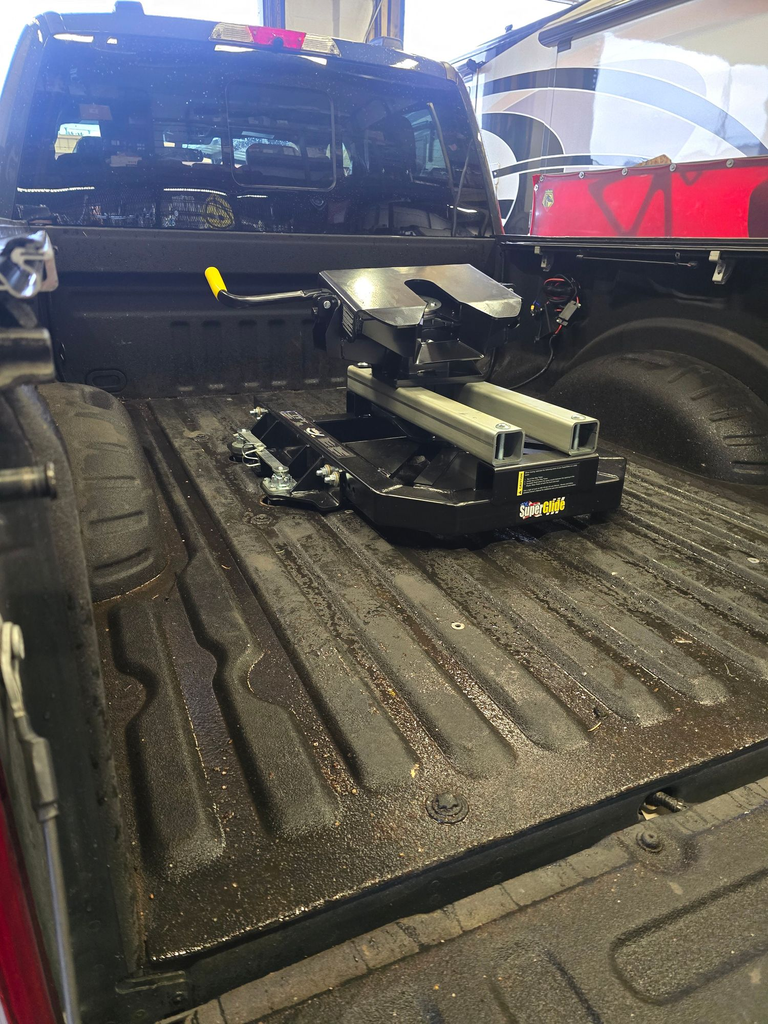
A slider that was needed in the old truck may or may not still be needed, and a standard hitch may need to become a slider on a shorter bed. For automatic sliding hitches such as the PullRite SuperGlide, the trailer’s Capture Plate stays with the trailer, but the hitch still needs a mounting path in the new truck.
7. New in-bed wiring location
The old in-bed connector stays with the old truck. The new truck may need its own connector placed and tested near the hitch. Some newer trucks can be prewired and just need a plug.
Used Hitches and Old Hardware
If you bring in a used hitch, Torklift Central can review its compatibility and condition before installation. That review covers whether the hitch and its components are correct for the new truck and in usable condition.
Old bolts, brackets, rails, and mounting hardware are not automatically reused. The hitch and mounting-system manufacturers’ instructions control what can be reinstalled and what must be replaced, including any replacement-hardware requirements. An adapter also does not automatically fix an incompatible combination. Its use depends on the hitch, the truck, and the ratings of every part involved.
Ratings follow the same logic. A newer truck with higher ratings does not make the old hitch rating irrelevant, and a higher-rated hitch does not raise what the truck is rated to tow. The lowest-rated component in the combination still sets the limit.
Transfer Review at a Glance
Fifth Wheel Hitch Transfer Review
| What changed | What may need replacement or review | Why it matters | What to verify before installation |
|---|---|---|---|
| Truck brand or generation | Hitch base or puck-specific mounting | Puck platforms differ by brand and can differ by generation | Whether the hitch maker offers a base for the new truck |
| Rails to factory pucks | Rails removed; adapter or puck base needed | Not every hitch supports a puck conversion | Manufacturer-supported adapter or base |
| New rail installation | Rail kit and frame-specific brackets | Brackets are matched to the frame | Correct rail kit and brackets for the new truck |
| Bed length | Hitch position or slider | Cab-to-trailer clearance changes | Clearance with your trailer’s front cap and pin box |
| Payload or axle rating | Nothing to install, but limits may change | Pin weight lands on payload and rear axle | Pin weight and trailer weight against new truck ratings |
| Used hitch or hardware | Bolts, pins, brackets, or components | Instructions control reuse and replacement | Hitch condition and manufacturer hardware requirements |
| In-bed wiring | New connector and circuit | Old wiring stays with the old truck | Connector type and placement near the hitch |
Bring the Hitch and the New Truck Information Together
The transfer question gets answered fastest when the team can see both sides at once. Gather:
- Old hitch manufacturer, model, and part number
- New truck year, make, model, bed length, and cab style
- Factory puck or prep package information on the new truck
- Trailer make, model, pin box information, trailer weight, and pin weight
- Photos of the hitch, the old mounting hardware, and the new truck bed
- Your in-bed wiring preference
- Old mounting-system information, such as rails, pucks, or underbed system. This can also be reviewed with a technician on site at the time of appointment.
For current pricing context, installing a hitch into existing rails or a factory puck system typically runs 1 to 2 hours and about $100 to $200 (labor only). A hitch with a new above-bed rail kit typically runs 3 to 5 hours, a sliding hitch installation 3 to 6 hours, and an in-bed wiring add-on 1 to 2 hours. Final pricing depends on the truck, the hitch, the mounting system, hardware condition, and access.
As a towing equipment provider and fifth wheel installer in Kent, WA, Torklift Central can review your existing hitch, confirm what the new truck needs, install it, and walk you through the setup before you tow. Schedule fifth wheel hitch service or call 253-854-1832. For a broader look at changing trucks or trailers, see our guide to rechecking your fifth wheel setup.
Key Takeaways
- A fifth wheel hitch may move to a new truck, but the mounting system, hardware, clearance, ratings, and wiring all need review.
- Puck systems differ by truck brand and can differ by generation, so a puck base does not automatically move between trucks.
- Some hitch families let the head transfer while the base changes, but the manufacturer must support the new configuration.
- Old bolts, brackets, and rails are not automatically reused. Manufacturer instructions control hardware reuse and replacement.
- A new truck does not make the old hitch rating irrelevant. The lowest-rated component still controls the combination.
Important Notices
Ratings Notice
Moving a fifth wheel hitch to a new truck does not increase the truck’s towing capacity, payload, GVWR, GAWR, or GCWR. Safe towing depends on the truck rating, payload, rear axle rating, tires, hitch rating, mounting system, trailer, pin weight, and accessories. The lowest-rated applicable component controls the setup.
Manufacturer Information
B&W, Companion, and Turnoverball are brands of B&W Trailer Hitches. PullRite and SuperGlide are brands of Pulliam Enterprises, Inc. Conversion and base options vary by manufacturer and model. Follow the current instructions for your hitch and mounting system.
Frequently Asked Questions
Can I reuse my fifth wheel hitch in a new truck?
Sometimes. The hitch head may transfer, but the new truck’s mounting system, bed length, clearance, ratings, hardware, and wiring all need review, and the hitch manufacturer must support the new configuration.
Can I move a B&W Companion to a new truck?
B&W states that the Companion line shares one coupler head and offers bases for Ford, Ram, and GM factory prep packages plus a single-point version for the Turnoverball. Moving a Companion often comes down to confirming the right base for the new truck.
Can I move a PullRite hitch to another truck?
It depends on the hitch series and the new truck’s mounting system. PullRite offers rail-mounted, OE puck, and rail-to-puck adapter options, so the transfer path is confirmed by the model and the new truck.
Do I need new fifth wheel rails?
If the new truck needs rails, the rails and their frame brackets usually have to suit the new truck. If the new truck has factory pucks, rails may not be needed at all, depending on the hitch.
Can a rail-mounted hitch work with factory pucks?
Some can, using a manufacturer-supported adapter or a different base. Not every hitch offers that path, so confirm with the hitch manufacturer and your installer.
Does bed length change fifth wheel fitment?
Yes. Bed length affects cab-to-trailer clearance and can change whether a standard hitch or a slider makes sense for your trailer.
Can fifth wheel wiring be moved to the new truck?
The in-bed connector and circuit are installed in the truck, so the new truck needs its own in-bed wiring placed and tested near the hitch.
Moving Your Hitch? Get It Reviewed First
Bring your hitch details and new truck information to Torklift Central in Kent, WA. The team will confirm what transfers, what needs to change, and install the setup before your next trip.
Call 253-854-1832 or schedule your appointment online.