
Build the order from the truck to the trailer: the right SuperHitch, the right SuperTruss length, the right wiring, and the right ball mount or weight distribution path.
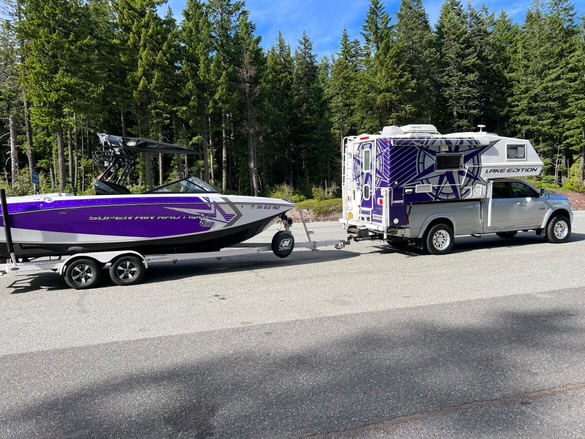
A complete SuperHitch and SuperTruss setup is a sequence, not a one-size bundle. Start with the vehicle-specific SuperHitch for your truck, measure camper overhang to choose the SuperTruss length, check that length's rating, add the matching wiring, then choose either a properly rated ball mount or a compatible single-receiver weight distribution system.
One rule to know before you start: SuperHitch Everest Weight Distribution is not compatible with SuperTruss. If your setup needs weight distribution through a SuperTruss, use a properly rated single-receiver weight distribution system. The steps below walk through every component in order.
Step 1: Confirm the Exact SuperHitch for Your Truck
Everything downstream depends on the hitch, so start here. Gather your truck details:
- Year, make, and model
- Bed length and cab configuration
- SRW or DRW
- Gas or diesel, where relevant
- Factory equipment, such as the factory receiver and rear bumper options
Then use Find Your Fit to identify the exact compatible SuperHitch. The SuperHitch Outlaw Series includes three rating levels. Hero 15K is rated for 1,500 pounds of tongue weight and 15,000 pounds of towing with weight distribution. Original 20K is rated for 2,000 pounds and 20,000 pounds with weight distribution. Magnum 30K is rated for 3,000 pounds and 30,000 pounds with weight distribution. These are the hitch ratings when towing directly from the SuperHitch. A SuperTruss has its own lower, length-specific ratings, covered in Step 3.
Do not choose a SuperHitch by its rating alone. Exact vehicle-specific fitment controls which SuperHitch applies to your truck. SuperTruss works exclusively with the SuperHitch series, because its dual-truss design connects to both SuperHitch receivers.
If you carry a camper with Torklift Outboard tie downs, also check now whether your SuperHitch changes the rear tie down application. More on that in Step 6.
Step 2: Measure Camper Overhang and Choose the SuperTruss Length
SuperTruss adds receiver length beyond the truck bumper so a trailer coupler clears the back of a truck camper. Current SuperTruss lengths are 21, 24, 28, 32, 36, 42, 48, and 60 inches.
With the camper loaded on the truck, measure from the face of the truck's rear bumper to the outside rear edge of the camper, and follow Torklift's current measuring guide for your setup.
Step 3: Check the Rating for Your Exact Length
SuperTruss does not have one universal capacity. Ratings change by:
- Extension length
- Weight-carrying configuration
- Weight distribution configuration
- The base SuperHitch, where the current chart lists additional limits
Find your length on the current SuperTruss rating chart and read the weight-carrying and weight distribution ratings for that exact row. A rating for one length never applies to another.
Then apply the lowest-rated-component rule. Your actual capacity is limited by the lowest applicable rating among the truck, SuperHitch, SuperTruss, ball mount, weight distribution system, hitch ball, trailer coupler, trailer, tires, and any other towing component in the chain.
Step 4: Choose the Wiring Extension or Harness
A receiver extension moves the trailer plug farther from the truck's 7-way connector, so plan wiring at the same time as the extension. Torklift offers length-matched 7-pin wiring pigtails for each SuperTruss length: W6021 (21-inch), W6024 (24-inch), W6028 (28-inch), W6032 (32-inch), W6036 (36-inch), W6042 (42-inch), W6048 (48-inch), and W6060 (60-inch).
If the truck camper and the trailer both need the truck's 7-way, Torklift also offers 3-way pigtails that send one 7-way connection up to the camper and one back to the trailer, sized by SuperTruss length range, plus a universal-fit truck-to-camper harness. The plug bracket that holds the trailer connector is included with SuperTruss.
To pick the right harness, answer four questions:
- Does the truck camper use the truck's 7-way connection?
- Does the trailer also need a 7-way connection at the end of the SuperTruss?
- Where are the existing connectors located on the truck and camper?
- Which current Torklift harness supports that exact configuration?
Step 5: Ball Mount or Weight Distribution, and Why Everest Is Not the SuperTruss Path
This is the most important decision in the order, and it depends on your trailer and load.
Weight carrying. If the complete setup stays within the current SuperTruss weight-carrying rating for your length, use an appropriately rated, compatible ball mount and towing components.
Weight distribution. If your trailer and load require the SuperTruss weight distribution rating, use a properly rated, compatible weight distribution system with a single-receiver connection at the trailer end of the SuperTruss. Torklift recommends a standard single-receiver weight distribution system that meets or exceeds the applicable SuperTruss rating.
Everest is not compatible with SuperTruss. SuperHitch Everest Weight Distribution uses a dual-shank, dual-receiver design. SuperTruss presents a single receiver at its trailer end, so Everest cannot connect to it. Do not order Everest for a SuperTruss setup.
Everest is still very much a SuperHitch product. It remains the weight distribution path when used directly in a compatible SuperHitch without a SuperTruss. The incompatibility applies only to the extension.
Weight distribution is also not required for every SuperTruss order. Plenty of setups run within the weight-carrying rating. Let your trailer weight, tongue weight, and the rating chart decide.
Finally, select the trailer connection hardware: a properly rated ball mount or weight distribution head and shank, a hitch ball, and hardware that matches your trailer coupler. There is no universal ball size. Your trailer coupler controls.
Step 6: Safety Chains, Trailer Brakes, and Rear Tie Downs
Two kinds of chains show up in a SuperTruss setup, and they do different jobs.
SuperTruss lateral-support chains stabilize the extension system itself. Torklift's FAQ notes that the turnbuckles on the SuperTruss should be hand tight, since a wrench can overtighten them.
Trailer safety chains connect the trailer to the towing system as required. SuperTruss lateral-support chains do not replace your trailer's safety chains.
Add any trailer electrical or braking equipment your trailer requires, such as a brake controller, according to the trailer manufacturer's guidance.
If the truck carries a camper secured with Torklift Outboard tie downs, confirm whether the SuperHitch you chose changes the rear tie down application. On many applications it does. Re-run Find Your Fit with the SuperHitch configuration selected so the camper side of the order is complete too.
Build the Order From the Truck to the Trailer
Use this table as a checklist. Not every setup needs every line, which is why a checklist works better here than a fixed bundle.
| Order component | When needed | How to select it | Common mistake to avoid |
|---|---|---|---|
| SuperHitch | Every SuperTruss setup | Find Your Fit for your exact truck | Choosing by highest rating instead of fitment |
| SuperTruss | When camper overhang requires receiver extension | Measured overhang plus the length-specific rating | Buying the longest length "just in case" |
| Wiring pigtail or harness | Whenever the trailer plug needs to reach the end of the extension | Match to SuperTruss length and camper/trailer connection needs | Assuming every setup uses the same harness |
| Ball mount | Weight-carrying setups within the SuperTruss rating | Rated for your load and matched to coupler height | Using a ball mount rated below the system |
| Single-receiver weight distribution | When the load requires the SuperTruss weight distribution rating | Meets or exceeds the applicable SuperTruss rating | Ordering SuperHitch Everest for a SuperTruss |
| Hitch ball and coupler hardware | Every towing setup | Matched to the trailer coupler and rating | Guessing ball size |
| Trailer safety chains and brakes | Every trailer, as required | Trailer manufacturer and legal requirements | Treating SuperTruss lateral chains as trailer safety chains |
| Rear Outboard tie downs | Trucks with camper tie downs when SuperHitch changes rear fitment | Find Your Fit with SuperHitch selected | Skipping the check because the order is "about towing" |
Key Takeaways
- Start with the exact vehicle-specific SuperHitch, then measure camper overhang to choose the SuperTruss length.
- SuperTruss ratings are length-specific and configuration-specific. Use the current chart for your exact length.
- Plan wiring with the extension. Length-matched pigtails and 3-way camper and trailer harnesses cover different setups.
- SuperHitch Everest Weight Distribution is not compatible with SuperTruss. Use a properly rated single-receiver weight distribution system when the load requires weight distribution.
- Recheck rear Outboard tie down fitment when installing SuperHitch on a camper truck.
Frequently Asked Questions
What do I need with SuperTruss?
A compatible SuperHitch, the correct-length SuperTruss, the right wiring pigtail or harness, a properly rated ball mount or single-receiver weight distribution system, a hitch ball matched to your coupler, and your trailer's required safety chains and brake equipment.
Do I need SuperHitch before buying SuperTruss?
Yes. SuperTruss works exclusively with the SuperHitch series. Confirm the exact SuperHitch for your truck first.
What SuperTruss length do I need?
Measure camper overhang with the camper loaded, following Torklift's current measuring guide, and choose the shortest length that provides the clearance you need. Then confirm the rating for that length.
Do I need a wiring extension?
In most SuperTruss setups, yes, because the trailer plug sits farther from the truck's connector. Choose a pigtail or harness matched to your SuperTruss length and camper wiring.
Can I use Everest with SuperTruss?
No. Everest uses a dual-shank, dual-receiver design, and SuperTruss has a single receiver at its trailer end. Everest is used directly in a compatible SuperHitch without SuperTruss.
What weight distribution hitch works with SuperTruss?
A properly rated, standard single-receiver weight distribution system that meets or exceeds the SuperTruss weight distribution rating for your length.
Do I need different rear tie downs with SuperHitch?
On many trucks, yes. Re-run Find Your Fit with the SuperHitch configuration selected to confirm your rear Outboard tie downs.
Is a ball mount included with SuperTruss?
Plan to select the ball mount separately so it matches your load rating and coupler height, and check the "What's Included" details on the current SuperTruss product page.
Plan Your Complete Extended Towing System
Start with Find Your Fit on Torklift.com to confirm your SuperHitch, then use the current SuperTruss chart to choose your length, wiring, and rating path. Want a second set of eyes on the full order? Call Torklift technical support at 1-800-246-8132 with your truck, camper, and trailer details.