
Choosing the best fleet vehicle upfitting shop in Seattle isn’t just about shelves and ladders—it’s about safety, uptime, and total cost of ownership. The right utility van upfitter will translate your daily field work into an efficient, safe mobile workspace, with documentation that satisfies OEM and fleet compliance. Below, we walk through a decision process that works for fleets in Seattle and surrounding areas like Tacoma, Bellevue, Everett, and Redmond.
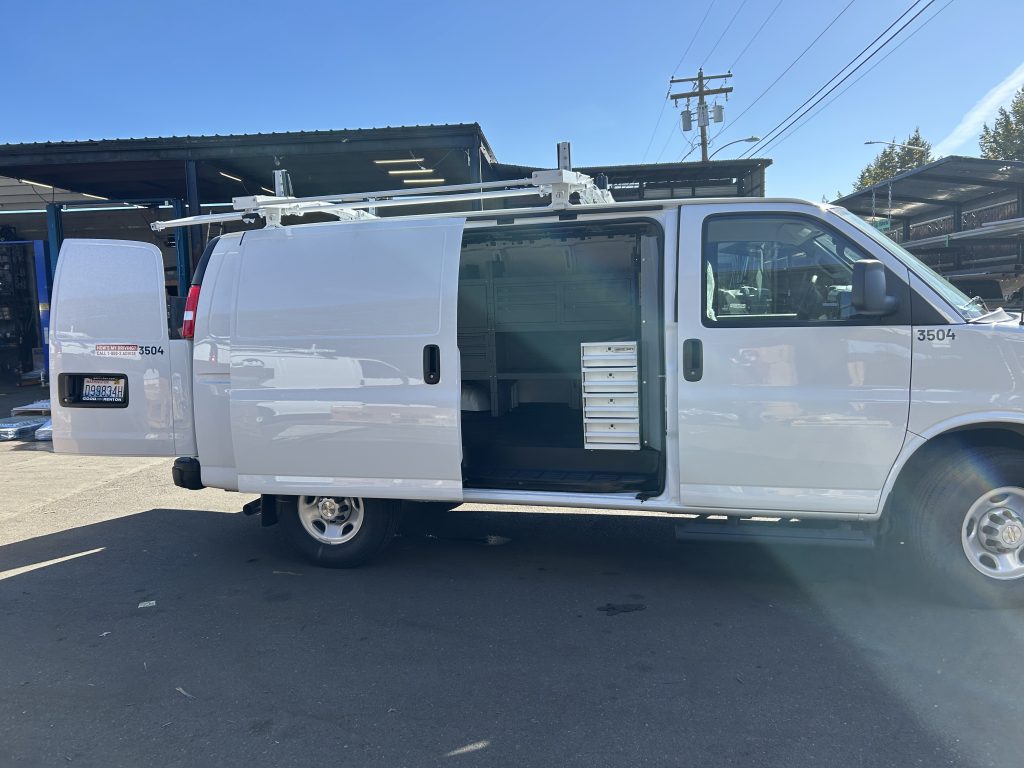
Understand Your Utility Van Mission and Payload Needs
Start with your mission-critical payloads—the tools, parts, consumables, and equipment your techs must carry every day—and design outward from that list. If you serve mixed trades (for example, plumbing and electrical), define profiles for each route or job type to avoid one-size-fits-all layouts that slow crews down.
Use actual vehicle utilization and fleet telematics data (the integrated use of telecommunications and information technology to monitor vehicles, assets, and driver behavior with real-time data) to right-size racking, drawer depths, partitions, and onboard power. Data beats guesswork: use actual vehicle utilization data to specify upfits and avoid costly over-specification (see these insider tips for choosing a Seattle fleet upfitter) insider tips to choose the best Seattle fleet upfitter.
Create a simple planning table and keep it updated as your service catalog evolves:
| Equipment/Tool | Quantity | Weight (lbs) | Daily Use (Y/N) | Power Needs (Y/N) |
| Cordless drill kits | 2 | 18 | Y | N |
| 28' fiberglass ladder | 1 | 35 | N | N |
| Inverter + outlets | 1 | 20 | Y | Y |
(And so on depending on your needs)
Tips:
- Group items by zone (driver side, curb side, bulkhead, roof) to minimize steps and ladder climbs.
- Flag heavy, high-frequency items for waist‑high access to reduce injury risk.
- If you operate electric vans, budget for DC‑DC converters or auxiliary batteries and confirm weight distribution within axle limits.
Plan Facility Visits and Review Past Projects
Before you sign, see the work in person. A high-quality shop should welcome tours and demonstrate how they manage consistency, safety, and speed.
What to look for on a tour:
- Process discipline: kitted hardware, labeled wiring
- Engineering-to-install integration: real-time collaboration between designers and techs to resolve fitment issues quickly.
- Manufacturing assets: laser tables, laser tube cutters, tube benders, robotics, 3D printing, and powder coating indicate the shop can build precise, durable, custom parts without delays.
- EV capabilities
Ask to review past projects that mirror your use case (construction, delivery, field service, municipal). Look for:
- Before/after layouts
- References from fleets operating in Seattle, Tacoma, Everett, and Bellevue.
- Documented timelines from purchase order to hand-off, including change-order handling.
How Torklift shortens the path from concept to keys:
- Single-source, in-house engineering, fabrication, and installation reduce handoffs and risk.
- Custom fixtures and robotic welding improve repeatability across multi-van orders.
- Rapid prototyping via 3D printing and laser-cut hardware accelerates approvals.
- Typical lead time: 1–2 days for simple, standard packages; 1–2 weeks for complex or multi-vehicle projects, depending on scope.
Ready to see how an integrated process can improve safety and uptime? Schedule a facility tour or request a spec review. Torklift serves Seattle and the wider region—Tacoma, Bellevue, Everett, Redmond, Kent, Renton, Lynnwood, Kirkland, Federal Way, Olympia, Puyallup, Bremerton, and beyond—with an all-in-house team and a manufacturing campus equipped with laser tables, laser tube cutters, tube benders, robotics, 3D printing, powder coating, and an in-house engineering design team. Get a quote today and put a data-driven plan behind your next van upfit.