

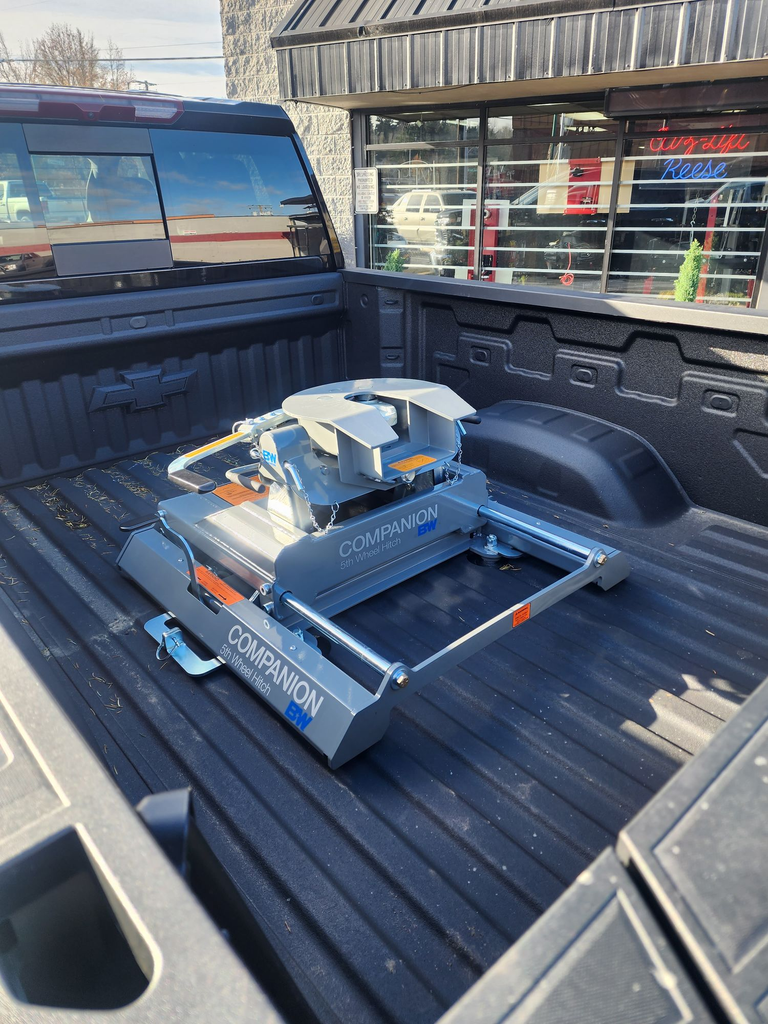
The Companion comes in several mounting styles. Here is how Torklift Central matches yours to your truck before installation day.
Most people searching for B&W Companion installation near Kent, WA start with one question: how soon can the truck get in? The better first question is which Companion your truck is set up for. B&W builds the Companion as a family of fifth wheel hitches that share the same coupler head but attach to the truck in different ways. One version drops into a B&W Turnoverball underbed system. Others lock into a truck manufacturer's factory puck platform or pin into industry-standard rails, and slider bases are offered for supported applications.
Torklift Central installs B&W fifth wheel hitches at our Kent facility, along with the mounting systems, adapter components, and in-bed trailer wiring that go with them. Truck owners come in from Seattle, Tacoma, Renton, Auburn, and across the greater Seattle area. This guide covers each Companion mounting path, what changes the installation, and what our technicians need from you before you schedule.
The B&W Companion Is a Hitch Family, Not a Single Part Number
B&W uses the same coupler head across the Companion line, then pairs it with the base that fits the truck. That is why two Companion owners can describe the same hitch and still need very different appointments. The coupler is the part you hook up to. The base, and whatever it mounts to, decides the job.
The features owners notice carry across the family. B&W uses a cam-action handle that keeps the jaws from opening when the handle is closed, jaws machined to fit the king pin closely, and a coupler that rides on polyurethane bushings to absorb road roughness. Holes in the base allow height and fore/aft adjustment for cab and bed rail clearance. B&W builds the Companion in the USA, certifies its fifth wheel hitches to SAE J-2638, and backs them with its own lifetime warranty, so warranty questions go to B&W under its current terms.
For installation planning, the Companion family breaks down into four configurations:
- Single-point Companion: mounts into a B&W Turnoverball underbed gooseneck system.
- Companion OEM: mounts to a compatible Ford, Ram, or GM factory four-puck platform.
- Rail-mounted Companion: pins into compatible industry-standard rails.
- Companion Slider: a sliding base offered with all available mounting styles (capacities may vary).
Single-Point Companion With a B&W Turnoverball
The original Companion is a single-point hitch. B&W's Turnoverball system mounts under the bed to the truck frame and leaves a 4-inch opening in the bed floor. The Companion base has a square post that drops into that opening, a latch handle in the wheel well engages a pin through the post, and a drawdown bolt on top pulls everything tight. Lift the hitch out and you have a clean, level bed again, with the option to drop the gooseneck ball back in.
The rule is simple: a single-point Companion only works on a truck with a compatible Turnoverball installed. The Turnoverball is truck-specific, so a truck without one needs that mounting system first. Installing a Companion into an existing Turnoverball and installing a Turnoverball plus a Companion are two very different appointments, and we quote them that way.
Two details to mention before your appointment. B&W states that wedge-style pin box couplers should not be used with the Companion or Companion Slider on the Turnoverball mount, because of the forces a wedge creates at that single attachment point. If your trailer has an aftermarket pin box, tell us the make and model. And if your truck has a plastic drop-in bedliner, the liner needs an opening large enough for the base or we can remove upon customer request.
Companion OEM for Ford, Ram, and GM Factory Puck Systems
Many heavy-duty trucks leave the factory with a fifth wheel prep package: four puck receivers in the bed, tied to frame-mounted structure underneath. B&W's Companion OEM bases are designed to lock into those factory platforms, so a prepped truck can run a Companion without adding rails or a Turnoverball.
Puck systems are not interchangeable between truck brands. Ford, Ram, and GM each use their own puck spacing, and B&W builds separate Companion OEM bases to match. A base built for Ford pucks will not drop into a Ram bed. Model year and the exact prep package matter too, which is why we ask for the B&W part number of any hitch you already own.
Because B&W sells Companion bases separately from the coupler, a hitch that started on one truck may need a different base to move to another. A common example is moving a Turnoverball Companion to a new truck with factory pucks. The right answer there is the correct B&W base for the new truck, not an improvised adapter. Bring the old base and its part number, and we can confirm what your truck needs.
When a truck already has a working puck system and the correct Companion OEM hitch, installation is typically one of the quicker fifth wheel jobs we handle. We still check the puck receivers, hitch engagement and handle operation, before the truck leaves.
Rail-Mounted Companion on Industry-Standard Rails
B&W also offers a rail-mounted Companion for trucks with above-bed rails. The base pins into compatible industry-standard rails, and the Companion coupler sets onto the upright arms. This is a separate hitch from B&W's Patriot, which is a lighter rail-mounted line with its own ratings. If you bought a rail-mounted B&W hitch, check the label so we know which one is coming in.
Existing rails are a starting point, not a guarantee. Before installing a rail-mounted Companion, our technicians confirm the rails follow the industry-standard pattern, that they are mounted with the correct truck-specific brackets and hardware, that they are in usable condition, and that the rail system's rating fits the trailer you plan to tow. If the truck has no rails, the rail kit becomes part of the job, which adds time and parts.
One tradeoff to know: rails stay in the bed when the hitch comes out. Turnoverball and factory puck setups are the paths to a flat bed when you are not towing.
Short-Bed Trucks and the Companion Slider
B&W offers slider versions of the Companion for supported applications. Pull the lever and the hitch slides back 12 inches, giving the trailer nose more room around the cab during tight maneuvers. Flip it again and the slider locks into the forward position as you back up.
B&W is clear that the rearward position is for maneuvering only, at maneuvering speed. For regular towing, the hitch belongs locked forward, because towing in the rear position places pin weight behind the rear axle. Our walkthrough at pickup covers how your slider locks and releases.
A short bed does not automatically mean you need a slider. B&W notes that many short-bed owners tow successfully with a standard Companion, depending on a few factors:
- Pin box location: whether the king pin sits even with the trailer's front or recessed behind it. Some fifth wheel manufacturers build extended pin boxes with short-bed trucks in mind.
- Trailer shape: narrower trailers and rounded front corners allow more cab clearance than wide, square-cornered caps.
- How you drive: frequent sharp turns and tight campgrounds call for more clearance than mostly highway travel.
A slider adds clearance. It does not remove the need to watch the trailer in tight turns, and it does not change your truck's towing or payload ratings. We review bed length, cab configuration, and trailer together before recommending fixed or slider.
What Torklift Central Needs to Know Before Installing Your Companion
The smoothest appointments start with complete information. When you call or request a date, have these details ready:
- Truck: year, make, model, bed length, cab configuration, and the payload and towing figures from your door-jamb label and owner's manual.
- Current mounting: whether you have a factory puck system (and which brand), a B&W Turnoverball, industry-standard rails, or nothing installed yet. Photos of the bed help.
- Hitch: the B&W part number if you already bought one, whether it is a standard or slider base, and any hitch you are replacing.
- Trailer: make, model, pin weight, and pin box make and model when available.
- Wiring: whether you want an in-bed trailer wiring connection added.
| B&W Companion setup | Truck preparation needed | What Torklift Central should confirm | What the customer should bring |
|---|---|---|---|
| Single-point Companion | Compatible B&W Turnoverball underbed system installed in the truck | Turnoverball fitment and condition, latch engagement, and pin box type (no wedge-style pin box couplers on this mount) | Truck details, Turnoverball information or photos, Companion part number, pin box make and model |
| Companion OEM | Factory fifth wheel prep package with four bed pucks | Puck brand matches the Companion OEM base, puck condition, hitch engagement, and clearance | Truck year, make, model, prep package details, B&W part number |
| Rail-mounted Companion | Compatible industry-standard rails, or a rail kit installed during the visit | Rail pattern, brackets, hardware condition, and rail rating | Rail brand or photos, hitch part number, trailer pin weight |
| Companion Slider | The mounting system that matches the slider base | Bed length, cab clearance, and slider lock and release operation | Bed length, cab style, trailer make and model, pin box location |
| In-bed wiring | Access to route wiring from the truck harness to the bed | Connector location near the hitch and a full function test | Trailer connector type and whether a brake controller is installed |
In-bed trailer wiring is worth adding during the same visit. It puts the trailer connection inside the bed near the hitch, which keeps cord routing cleaner when the pin box is over the bed. Our team installs and tests the connection before you leave. Learn more about trailer wiring.
One more point before you tow. A fifth wheel hitch does not increase your truck's towing capacity, payload, GVWR, GAWR, or GCWR. The complete setup has to stay within the truck manufacturer's limits and the ratings of the hitch, mounting system, trailer, pin weight, axles, tires, suspension, and accessories, with the lowest-rated component setting the limit.
Use our scheduling form to request a date. Requested dates are not always immediately available, and our team confirms your appointment after reviewing the fitment details.
Key Takeaways
- The B&W Companion is a family: single-point for the Turnoverball, Companion OEM for factory pucks, and rail-mounted, with slider bases for supported applications. The base has to match your truck.
- A Companion going into an existing Turnoverball or puck system is a quicker job than one that needs the mounting system installed first.
- Factory puck systems are brand-specific, so a Companion OEM base built for one truck brand will not fit another.
- A short bed does not automatically require the Companion Slider. Pin box location, trailer shape, and how you maneuver all factor in but is highly recommended.
- Bring truck details, the B&W part number, your mounting system information, and trailer pin box details when you schedule.
Frequently Asked Questions
Where can I get a B&W Companion installed near Kent, WA?
Torklift Central at 315 Central Ave N in Kent installs B&W fifth wheel hitches, including Companion configurations, for truck owners throughout Kent, Seattle, Tacoma, Bellevue, and the greater Seattle area. Call 253-854-1832 or request a date through our scheduling form.
Can you install a B&W Companion into my truck’s factory pucks?
Yes, when it is the correct Companion OEM model for your truck's Ford, Ram, or GM puck system. A single-point Companion built for the Turnoverball needs a different base to work with factory pucks.
Can you install a Companion with a Turnoverball I already have?
Yes, as long as the Turnoverball is compatible and in good condition. If your truck does not have a Turnoverball yet, we quote the mounting system and the hitch together.
Do I need a Companion Slider for my short-bed truck?
Recommended, especially for those that are new to towing a fifth wheel.
Can you install a Companion I bought somewhere else?
Yes. Torklift Central installs customer-supplied hitches when the hitch, mounting kit, rails, hardware, and wiring are correct for the truck and in usable condition with no missing parts. Bring the part number so our team can review fitment before installation.
Can Torklift Central add in-bed trailer wiring with my Companion installation?
Yes. In-bed wiring is a common add-on to a fifth wheel installation. Our current typical range is 1 to 2 hours and $75 to $150, depending on the truck and wiring needs.
Will a B&W Companion increase my truck’s towing capacity?
No. A fifth wheel hitch does not change your truck's towing capacity, payload, or axle ratings. Your setup has to stay within the truck manufacturer's limits and the lowest-rated component in the system.
Schedule B&W Companion Installation in Kent, WA
Torklift Central has served Kent as a hitch installer and towing equipment provider since 1976, and our technicians install B&W Companion hitches, mounting systems, and in-bed wiring for truck owners across the greater Seattle area. Schedule fifth wheel hitch installation or call 253-854-1832 with your truck and hitch details for a truck-specific quote.