
A clearance-first checklist for front-mounted racks and carriers, from approach angle to cameras and airflow.
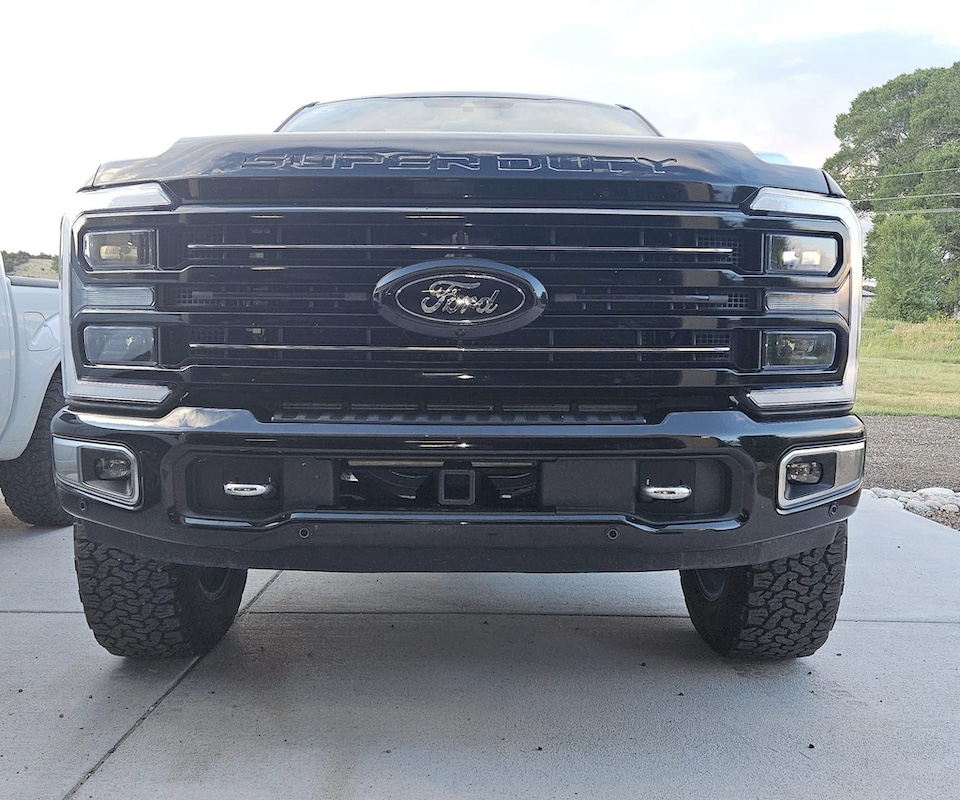
Before you attach a bike rack or cargo carrier to a NorthHitch front receiver, check six things: the hitch rating for your exact truck, your truck's front axle limit, the accessory's own rating and loaded weight, ground and approach clearance, clearance to the bumper and grille, and anything the accessory might block, including lights, cameras, sensors, and airflow.
A front receiver's published capacity tells you what the hitch can handle. It does not approve every rack, carrier, or load you might put on it. This guide focuses on clearance and real-world use. If you are still choosing a front hitch, start with our NorthHitch front receiver buying guide.
Start With the NorthHitch for Your Exact Truck
NorthHitch is engineered for specific trucks and vans, and ratings vary by application. For example, the NorthHitch X7921 for 2023 to 2026 Ford F-250 and F-350 is listed at 1,000 pounds tongue weight, 10,000 pounds trailer weight, and 10,000 pounds line pull, while the NorthHitch X7924S for the Chevrolet BrightDrop is listed at 750 pounds tongue weight and 10,000 pounds line pull. Plan around the ratings for your part number, not a number you saw on another truck.
Tongue Weight and Line Pull Are Different Ratings
Tongue weight is the downward load on the receiver from a trailer tongue, bike rack, or cargo carrier. Line pull is the straight pulling load used for front-mounted winching. A 10,000-pound line pull rating says nothing about how much a rack can hold, because racks and carriers load the receiver downward.
Racks and carriers also hold weight out in front of the receiver, and that leverage reduces effective tongue weight capacity. Add the accessory weight and everything on it, then run the setup through Torklift's Maximum Hitch Weight (Tongue Weight) Estimator.
Front Axle Weight: The Limit Owners Overlook
Everything on a front receiver adds load to the front axle, and because the load sits ahead of the axle, leverage makes its effect on that axle larger than its weight alone. The front of a truck already carries the engine, so front axle capacity can run out before the hitch rating does.
Find your front gross axle weight rating (GAWR) on the door-jamb label or in your owner's manual. If you are close, weigh the truck at a scale with the accessory loaded. A heavy front load can also change front ride height, which affects how the truck sits and drives.
Ground Clearance and Approach Angle
A front-mounted accessory reduces approach angle, the angle at which the front of the truck can climb onto a ramp, curb, or driveway without the lowest point making contact. Steep driveway entries, curb cuts, boat ramps, and snow berms are where front accessories scrape.
Measure on level ground with the accessory loaded: the height from the ground to the bottom of the receiver, the lowest point of the accessory and its cargo, and how far the accessory extends ahead of the bumper. Then test slowly on the steepest transition you drive regularly. On bike racks, watch for wheels and pedals hanging below the platform.
Bumper, Grille, and Turning Clearance
Rack arms and carrier frames can sit close to the bumper and grille. Check the gap at rest, and check it again if the rack tilts or folds, because tilt features designed for rear use may not have room to operate in front.
Width matters too. A carrier wider than the bumper corners extends the truck's footprint, which changes how you turn into tight parking spots and gas stations. Walk around the truck with the accessory installed and note what sticks out.
Visibility, Lighting, Cameras, and Airflow
A front accessory can block things the truck needs to see and be seen. Before driving, check each of these with the accessory loaded:
- Lights: headlights, turn signals, and fog lights should stay visible. Check at night, and follow local rules on obstructed lights and plates.
- License plate: if the accessory covers it, plan a relocation before you drive.
- Cameras and sensors: front cameras, parking sensors, and radar for driver-assistance systems may be blocked or may display warnings. Check your owner's manual for how your truck handles obstructions. A front-mounted accessory may limit some of these functions.
- Airflow: a loaded carrier directly in front of the grille can reduce airflow to the radiator and other coolers. Leave the grille as open as possible, especially when towing or in hot weather, and watch your temperature readings.
Receiver and Shank Compatibility
Match the accessory shank to the receiver size for your NorthHitch, which on the examples above is 2 inches, and use the correct hitch pin. Avoid adapters and extenders that add length, since every added inch increases leverage and reduces effective capacity.
Finally, confirm the accessory manufacturer allows front-receiver mounting. Some racks and carriers are designed and rated only for rear use. A rack that fits the receiver is not necessarily approved for the front of a truck.
Find the NorthHitch for Your Truck
NorthHitch gives you a front receiver engineered for your specific truck, with published tongue weight and line pull ratings you can plan around. Find the NorthHitch for your truck, then use the checklist above before your first trip. Torklift Central ships nationwide, and if you are near Kent, Washington, our technicians can install your NorthHitch and review accessory clearance with you on the truck. Start with our NorthHitch buying guide to locate the right part number.
Key Takeaways
- NorthHitch ratings are vehicle-specific; plan around the tongue weight and line pull for your exact part number.
- Line pull covers winching, while racks and carriers load the receiver downward and fall under tongue weight.
- Front accessories add load to the front axle and reduce approach angle, so check GAWR and test clearance loaded.
- Check lights, plate, cameras, sensors, and grille airflow with the accessory installed; a front accessory may limit some vehicle functions.
Frequently Asked Questions
Does a 10,000-pound line pull rating mean my front rack can hold more?
No. Line pull applies to straight pulling such as winching. Racks and carriers fall under the tongue weight rating, and leverage reduces their effective capacity.
How do I know if my truck can handle a front cargo carrier?
Check your NorthHitch tongue weight rating, your front GAWR, and the carrier's rating, then stay within the lowest. Weigh the truck if you are close.
Will a front bike rack block my cameras or sensors?
It may. Front cameras, parking sensors, and driver-assistance radar can be blocked or display warnings. Check with the accessory installed and review your owner's manual.
Can I use my rear bike rack on the front?
Only if the rack manufacturer allows front-receiver mounting and it fits your receiver size and ratings.
Does a front cargo carrier affect engine cooling?
It can. A loaded carrier in front of the grille may reduce airflow. Keep as much of the grille open as possible and watch temperatures, especially when towing.
Is there a standard clearance measurement I should meet?
No. Clearance depends on your truck, the accessory, and where you drive. Measure your own setup loaded and test it on your steepest regular transition.
Find the NorthHitch for your truck using our NorthHitch buying guide, then call Torklift Central at 253-854-1832 to review accessory clearance before you order.
IMPORTANT NOTICE: While NorthHitch® trailer hitches are built with high-strength materials and tested for exceptional weight ratings, your vehicle's factory towing capacities are the ultimate limit. Always refer to your vehicle's owner's manual to determine its maximum towing and tongue weight ratings. No aftermarket hitch or accessory can increase your vehicle's factory-rated towing capacities.
Using hauling accessories like extensions, cargo trays, bike racks, or other accessories that extend the load out from the trailer hitch, will significantly reduce the tongue weight capacity of your hitch system.
To estimate how your setup will affect tongue weight, we recommend using our Maximum Hitch Weight (Tongue Weight) Estimator before hauling your payload (cargo trays, bike racks, etc).
Disclaimer: It is the user's responsibility to ensure safe towing practices and to confirm that all loads fall within the limits of the lowest-rated component in the towing system. Torklift is not liable for any damage or injury resulting from the misuse or overloading of towing/hauling equipment.